Strategy Isn’t a Plan. It’s How You Win.
A companion piece to Building a Scalable Business Is Just Like Building a StrongHouse.
In that article I broke a scalable business into its parts: data and automation, growth and execution, customer experience, your people, and strategy. One of those parts deserves its own deep dive because it’s the one people misunderstand the most: strategy.
Most companies point at things that aren’t strategy and call them strategy. They spend months “working on strategy” and end up with a to-do list. Then they wonder why nothing actually changes.
Here’s what strategy actually is, what it absolutely is not, and a simple process to build one that holds up.
Key Takeaways
- Strategy is your theory on how to win, not a plan, budget, goal, or mission statement.
- A real strategy forces hard choices about where you’ll play and how you’ll be better than the competition.
- Strategy is a theory, not a guarantee. You test it, learn, and adjust.
- Use PESTLE → SWOT → TOWS to build real strategic moves.
- Always sunset old work before piling on new strategy work.
What Strategy Is
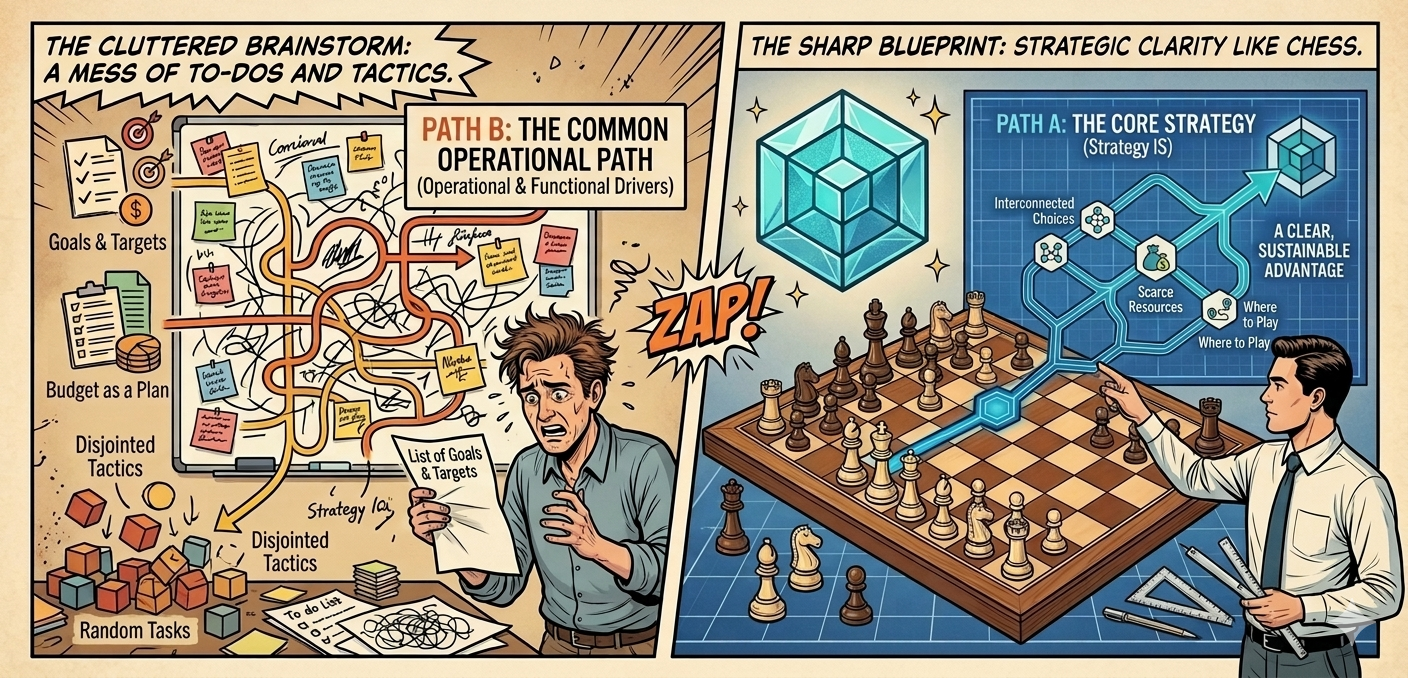
Strategy is your theory on how to win. That’s it. It’s the clear, honest picture of where you want to go, why that playing field and not another, and how you intend to be meaningfully better than the people you’re competing against. It’s a basic set of decisions: where you’ll play, how you’ll win, and what you have to be great at to pull it off.
A real strategy does three things at once. It sets directionand paints a future state clear enough to anchor everyone. It names how you’llwin and gets your people, resources, and operations aligned behind that choice. Finally, it spells out how you’llsustain success over time and how you’ll know you’re getting there.
A good strategy forces you to answer a handful of toughquestions:
- Why this market and not another?
- How will we be meaningfully better than our competitors,not just another option?
- Where do we want to grow, and where are we willing to pivot?
- What capabilities and systems do we need to win?
- What must be true for this to work?
Notice that every one of those questions is about choice and direction, not an activity or task. A company competing on lowest price needs a completely different machine than one competing on premium service and deep relationships. Strategy is the decision about which machine you’re building, and why that’s the one that wins.
Knowing this is a Game Changer: Strategy Is a Theory
Here’s the part people forget or may not even know. A strategy is a theory, not a guarantee. You’re placing a bet on an uncertain outcome, mostly on how customers or competitors may behave. You can’t control behavior the way you control a budget. That’s exactly why it’s strategy and not just planning. A theory has to be tested. You put it into the market, watch what actually happens, learn, then adjust or pivot. Keep the parts that prove true and change the parts that don’t.
A strategy should feel a little uncomfortable because youcan’t predict an exact outcome. It’s an educated guess, not a sure thing.
What Strategy Isn’t
This is where most of the confusion lives. Strategy gets blamed for a lot of things that aren’t strategy. Let’s clear those away.
Strategy isn’t your plan. A plan is the timeline, the budget, the projects, and the who does what by when. Planning is comfortable because it deals with resources you control. Strategy is uncomfortable because it deals with an outcome you don’t: customers choosing you over someone else. Good plans are required to execute strategy, but a Gantt chart is not a theory of how you win.
Strategy isn’t a budgeting exercise. Deciding how to spend next year’s money is important, but it’s a resourcedecision, not a theory of how you win. Budgets should be decided based on strategy,not stand in for it. If your “strategy meeting” is really just a fight overline items, you haven’t done strategy yet.
Strategy isn’t your goals. “Grow revenue 30%” is a goal. It’s a number you want to hit. It says nothing about how you’ll beat the competition to get there. Goals measure progress. Strategy explains the winning. When someone says “our strategy is to double in three years,” they’ve named a target and left the strategy out.
Strategy isn’t your tactics. Running ads, hiring a sales rep, and launching a feature are all tactics. They’re steps down the path in executing strategy. Tactics without a strategy behind them are efforts that burn cash and make you look busy. If your tactics can’t trace back to a clear choice about how you win, you don’t have a strategy, you have a habit.
Strategy isn’t crisis management or fire drills. Reacting to the fire in front of you is survival, not strategy. Crises will always grab attention, but if firefighting is the only thing setting your direction, you’re letting the world choose your moves for you. Strategy is what keeps you pointed somewhere on purpose even while you handle what’s urgent.
Strategy isn’t a mission statement. “We strive to make customers happy through excellence and innovation” is a poster, not a plan to win. Real strategy requires trade-offs and hardlines of what you will and will not do. If no competitor would care about it and it doesn’t force any real choices, it isn’t strategy.
Strategy isn’t a one-time event. Because it’s a theory, it has to be tested and revisited. A strategy you set once and never look at again is just a guess you got attached to.
Strategy is the why and the how we win. Everything else (the goals, the plans, the tactics, the budget) is a derivative of strategy.
Why Getting This Wrong Is So Expensive
When strategy is uncertain, the rest of the business slowly begins to break down. Teams pull in different directions because there’s no clear vision of how you win. You chase every opportunity because you never decided which game you’re playing. Resources get spread thin. Good execution ends up targeting the wrong destination, which is worse than bad execution. You move fast but drain resources while heading in the wrong direction.
The damage doesn’t announce itself. It just quietly builds up until the parts of the business you worked so hard to establish break down. That’s why it’s worth slowing down and setting strategy deliberately.
How to Build Your Strategy
Building strategy is easier than you think. You don’t need a90-page PowerPoint or an expensive offsite. You do need to work through a process: set your boundaries, scan the environment, examine your position, pressure-test it against your competition, then set your moves and turn them into a plan. Each step has a simple, proven framework behind it. You don’t have to be academic about it, but the tools keep you honest.
Start by Setting Your Boundaries (Mission and Values)
Before anyone brainstorms a single move, go back to two documents you already have: your mission statement and your company values.
I know I said a mission statement isn’t a strategy. It isn’t, but it is the fence you set strategy inside of. These are the only boundaries that should exist for your initial brainstorming, and they do two important things.
First, they keep the ideation from drifting into spaces outside your core purpose and the people you want to serve. It’s easy in a room full of ideas to talk yourself into a market that has nothing to do with why you exist. Your mission keeps you honest about that.
Second, revisiting your values reminds everyone how to treat each other while you brainstorm. Strategy sessions get tense. People are arguing about the future of the business. Your values set the tone for how that argument is allowed to happen. Set those guardrails first, then open the field.
How to Run These Sessions (So They Actually ProduceSomething)
The tools below are just that, tools, and will only work if you start the strategy session off correctly. Most strategy sessions fail: the highest-paid person talks first, everyone nods, and the room leaves with one opinion dressed up as analysis. A few simple rules keep that from happening.
Write before you talk.
For each prompt/question, give everyone a few quiet minutes to write their own answers on sticky notes or in a shared doc before anyone says a word out loud. You’ll surface what the quiet people see and stop the loudest voice from anchoring the room.
So what?
Why does it matter to our business? This is a filter that turns lists of interesting topics or facts into useful information. What is the impact on our customers, margins, market position, or ability to compete? If you can’t connect it to something that matters to your business, then throw it out.
Vote to prioritize.
After each step below (PESTLE – SWOT – TOWS) vote on the answers from the group to bubble up the most important and move them forward to the next step. Once you complete the TOWS, vote then assign ownership to the surviving ideas. An insight with nobody’s name on it dies on the whiteboard.
Step 1: Scan the Environment (PESTLE)
Before you decide how to win, you have to see the field clearly. PESTLE is a tool to identify outside forces you don’t control but absolutely have to account for. Work each one with the prompts, then push every answer through the “so what" for us test.
- Political: regulation, trade policy, government priorities. Ask: What policy or regulatory change could alter what we’re allowed to do or sell? Who holds power over our market, and where are they headed?
- Economic: interest rates, inflation, growth, customerspending power. Ask: How is our customers’ ability and willingness to spend changing? If the economy tightened or boomed next year, who feels it first — us or them?
- Social: demographics, buyer behavior, cultural shifts. Ask: How are our customers’ habits, values, or makeup shifting, and are we shifting with them? What do buyers expect today that they didn’t three years ago?
- Technological: new tools, automation, disruption in yourspace. Ask: What technology could make what we do faster, cheaper, or obsolete? If a competitor adopted it before us, what would we lose?
- Legal: laws, compliance, liability. Ask: What compliance, contract, or liability risk could bite us, and are we current on it? Which legal change would force us to change how we operate overnight?
- Environmental: sustainability pressures, climate, resource costs. Ask: What resource or sustainability pressure affects our costs, supply, or reputation? Do customers and partners increasingly expect us to act, and what happens if we don’t?
The point isn’t to fill in six boxes and feel productive. It’s to catch the shifts you may otherwise miss from being busy with your day-to-day schedule; the pending regulation, the demographic change, the technology that’s about to reset your industry. The winners here become the main external items for the Opportunities and Threats in your SWOT.
Step 2: Examine Your Position (SWOT)
Now turn the lens on yourself. SWOT maps where you stand. The trap is that people fill it with opinions and wishes, so tie every entry to evidence and real numbers. War stories can be informing and entertaining, but be cautious not to use anecdotal stories to represent what is actually going on. Use real numbers, even if imperfect to avoid one-off events.
- Strengths: what you’re genuinely great at (internal). Ask: What do customers consistently praise or come back for? What can we do that competitors can’t copy quickly? Where do we win deals, and why?
- Weaknesses: where you’re exposed (internal). Ask: Where do we actually lose deals or customers, and what’s the real reason? What would a departing employee say is broken? What are we pretending is fine that isn’t?
- Opportunities: openings in the market (external). Ask: Which shift from our PESTLE scan opens a door for us specifically? Where is a competitor stumbling or a customer need going unmet?
- Threats: dangers on the horizon (external). Ask: Which PESTLE shift could hurt us if we do nothing? What are we most exposed to that we keep avoiding?
Here’s the trick most people miss: your Opportunities and Threats should come straight out of your PESTLE scan. That’s how the two steps connect. PESTLE tells you what’s happening in the world and SWOT translates it into what it means for you. Be brutally honest here. A strategy built on strengths you wish you had is just a wish.
Sharpen Your Threats: Think Like Your Toughest Competitor
Most teams are soft on the Threats box. They list a few obvious dangers and move on. So before you leave SWOT, run a short exercise that forces real threats to the surface.
The setup is simple: take 20 minutes and roleplay as your competitor. You are now your most dangerous competitor, and your only job is to take this company’s customers, talent, and market position away from it. Be aggressive. Be imaginative. What would you do to us if you had no loyalty to us?
Name three to five specific moves that competitor would make. Then step back into your own shoes and debrief two questions:
- Which of these threats is most concerning?
- Which is most realistic in the next three to five years?
The threats that are both concerning and realistic go straight into your SWOT, and they’ll usually become the sharpest inputs to the moves you generate next. Taking on the mindset of a harsh competitor may feel uncomfortable, but it’s better to feel that discomfort in a conference room than in the market.
Step 3: Set Your Moves (TOWS)
This is the step most will skip, however it’s the one that turns analysis into strategy. What you have after completing the PESTLE & SWOT is nothing more than a well thought out list. TOWS makes it do something by crossing your internal factors against your external ones to produce actual moves. The key is to be specific: don’t cross whole categories in the abstract. Take one real strength, weakness, opportunity, or threat at a time, pair it with another, and ask what that pairing makes possible.
- Strengths + Opportunities: your boldest, offensive plays. Ask: Which specific strength could we aim straight at the biggest opportunity on the board, and what’s the boldest move that pairing makes possible? If we doubled down where we’re strongest, what would we go after first?
- Strengths + Threats: defend with what you’ve got. Ask: Which strength can we turn into a shield against the threat that worries us most? If a competitor made their most aggressive move tomorrow, what do we already have that neutralizes it?
- Weaknesses + Opportunities: fix or build to capture. Ask: Which weakness is blocking an opportunity we could otherwise take, and what’s the smallest fix that unlocks it? What do we need to build, buy, or partner for to get in the game?
- Weaknesses + Threats: protect or step back. Ask: Where does a weakness meet a threat in a way that could really hurt us, and how do we cut that exposure? What situation do we most need to avoid, and what do we do now to stay out of it?
Work through those four combinations and you’ll have a shortlist of real strategic moves grounded in the actual field and your actual position. Write each one as an action someone could own, and name what you’d have to stop or trade off to make it real. A move with no trade-off usually isn’t a real choice.
Choose, Test, and Adjust
You can’t do everything on that list. Strategy is about choice, so pick the moves that best answer “how do we win,” commit to them, and put them into the market. Then watch what happens.
Remember, your strategy is only a theory. You must give your team room to fail, as failure is the only way to learn and pivot. Keep the parts that prove true and change out the parts that don’t.
Make Room: Sunset the Old Before You Pile On the New
Here’s the step almost every company skips, and it quietly destroys execution.
Most organizations explore new strategies, get everyone excited, and roll out the path for executing them. What they almost never do is go back and sunset the old strategies the new ones just replaced. The work tied to those old strategies keeps running, the reports still get built, the meetings still happen, and the metrics nobody acts on still get tracked.
Then you ask your people to take on everything new on top of all of that. That’s how you burn out your best people. Piling on new work without removing what’s no longer necessary leads to burnout, turnover, and, ironically, worse execution of the very strategy you’re excited about, because attention and focus get split across old work that no longer matters.
So build an audit into your rollout. When you commit to new moves, go find the work that was serving the old ones and ask a blunt question of each: does this still serve where we’re going? If it doesn’t, kill it, and tell people plainly that stopping it is now part of the plan. Making room for the new strategy is part of executing it.
Build a Strategy That Lasts
Strategy isn’t the busy work of running your company. It’s not your plan, your goals, your tactics, your budget, or a nice sentence on your website. It’s your best theory of how you win; the thing that keeps every other part of the business pointed in the same direction.
Set your boundaries. Scan the environment. Examine your position honestly, and pressure test it against your toughest competitor. Set real moves from what you find. Make room by sunsetting the work that no longer fits. Then choose, test, and adjust.
Do that, and you won’t just have a business that grows. You’ll have one built to stay standing through whatever comes.